Viewing an Age-Old Problem from a New Angle
Difficult urinary catheterization (DUC) is a long-standing challenge in clinical care—one that leads to significant patient discomfort and almost always requires escalation of urologic intervention.
We define DUC as any catheter insertion that fails to reach the bladder on the first attempt. The underlying causes are often due to under-appreciated variations in individual anatomy and physiology.
One Such Cause: Prostate Anatomy
One potential pitfall as the urethra passes through the prostate gland on its way to the bladder is that it doesn’t always follow a straight path. Instead, it tends to deviate anteriorly after passing the midpoint of the gland.
This deflection creates what’s known as the prostatic urethral angle (PUA).
The average PUA in patients with benign prostatic hyperplasia and lower urinary tract symptoms is approximately 34 degrees
Different studies suggest patients with a higher PUA (often over 35 or 40 degrees) have a greater likelihood of reduced urine flow rate and other lower urinary tract symptoms because of a more bent urethra
Overall, PUAs can vary widely—from 0 to 90 degrees
This variability has significant clinical ramifications. A steeper angle can make it much more difficult for standard urinary catheters to navigate smoothly into the bladder.
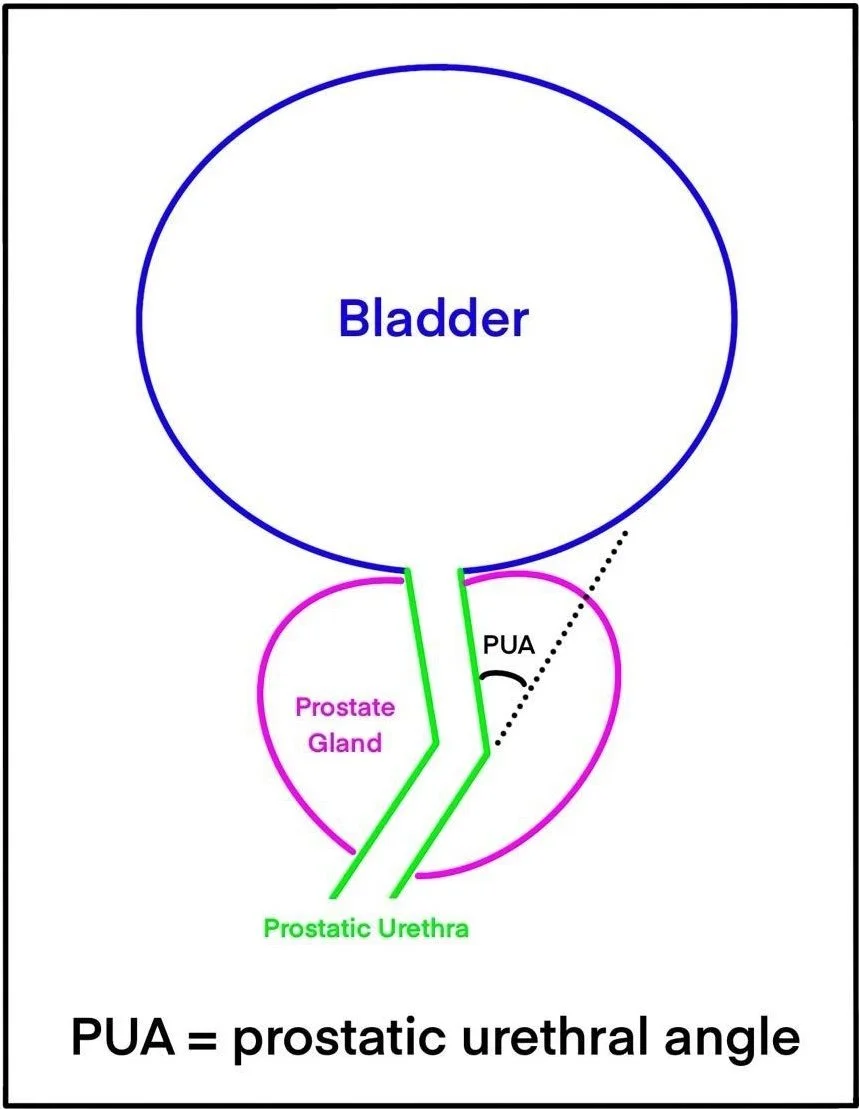
Concept adapted from Cho HS et al., Urology, 2008
Why Current Catheters Fall Short
Most existing urinary catheters are designed with a relatively fixed shape. They do not adequately accommodate the wide range of PUAs seen in patients.
As a result:
Catheters may fail to get beyond the prostate gland
Multiple insertion attempts may be required
Patient discomfort and risk of injury increase
In short, the greater the PUA, the higher the likelihood of DUC.
A New Approach: Designing for Variability
To address this challenge, the team at Foldé has taken a fresh approach.
Rather than designing for a “typical” anatomy, Foldé has developed a urinary catheter with a flexible tip intended to adapt to each patient’s unique PUA.
This innovation aims to:
Improve first-attempt insertion success
Minimize patient discomfort and complications
Looking Ahead
Considering PUA variability is just one example of how Foldé hopes to achieve its simple, but impactful goal: make urinary catheterization more reliable for providers and less traumatic for patients.
Foldé
Reshaping the future of urinary catheterization.